 crxbase
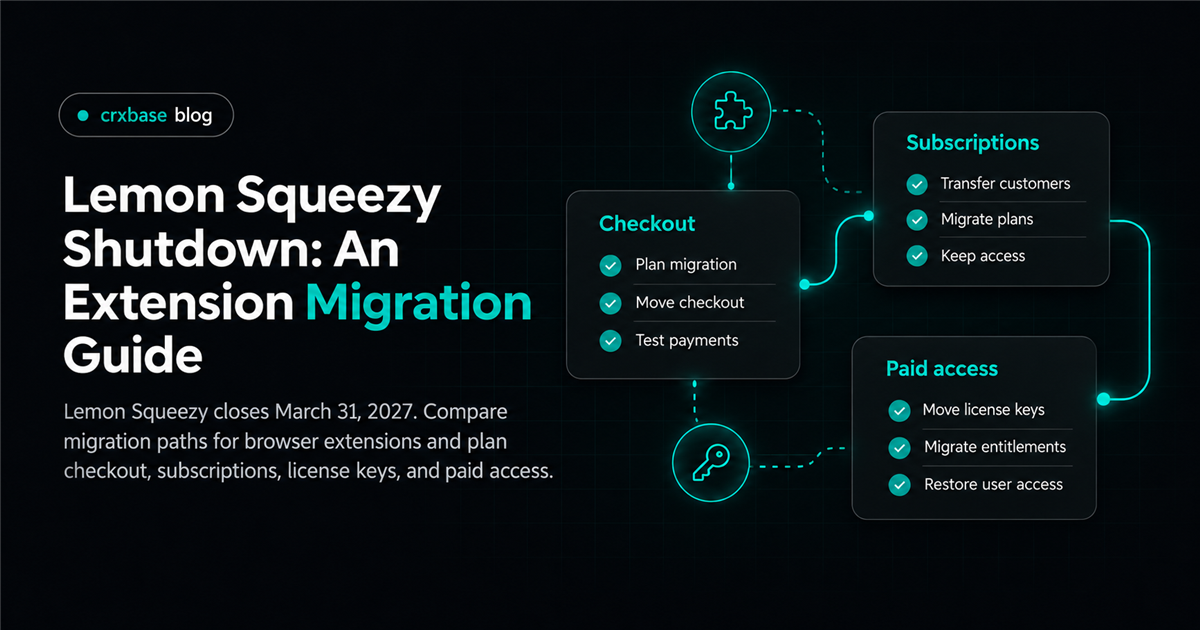
Lemon Squeezy will stop processing transactions, including subscription renewals, on March 31, 2027. If your extension uses it to sell subscriptions or validate license keys, replacing the checkout link is only one part of the move. You also need a plan for existing billing and the features each customer already paid for. Lemon Squeezy's migration guide sets out the deadline and available routes.
This guide helps you inventory your customers, choose a destination, and verify access before switching traffic. We built crxbase, one of the options discussed below. Its setup supports new extension purchases through Stripe, but the documentation does not establish an automatic import of existing Lemon Squeezy subscriptions.
Key Takeaways
- Plan checkout, recurring billing, and paid access as separate workstreams.
- Check each subscription's payment method and destination eligibility before promising an automatic transfer.
- Keep a separate plan for license keys, lifetime buyers, and installed extension versions.
- Reconcile customer access and billing dates before retiring the old flow.
What changes when Lemon Squeezy closes?
Existing stores can continue processing while they prepare, but transactions and renewals stop on March 31, 2027. Lemon Squeezy closed new store sign-ups on November 16, 2026, and says its guided Stripe Managed Payments migration tooling is scheduled for December 2, 2026. It recommends starting no later than mid-January 2027; that is a planning recommendation, not another shutdown date. The company estimates a complete move can take four to eight weeks. Lemon Squeezy migration guide, wind-down FAQs.
| Date | Planning milestone |
|---|---|
| November 16, 2026 | New store sign-ups closed |
| December 2, 2026 | Managed Payments migration tooling scheduled to launch |
| Mid-January 2027 | Recommended latest start |
| March 31, 2027 | Transactions and subscription renewals stop |
A payment provider records a transaction. Your extension also needs a way to identify the user and determine their entitlement: the record of which features that user can use. If Lemon Squeezy validates your keys, plan a replacement for that dependency as well. Stripe Managed Payments does not provide Lemon Squeezy's license-key or file delivery features, according to Lemon Squeezy's fulfillment guidance.
For the tradeoffs behind merchant responsibility, see our Stripe and merchant-of-record comparison.
Step 1: Inventory customers and extension integrations
Start with a list that connects every paid customer to their billing record and their extension access. You need enough information to compare the old and new systems, not just a list of email addresses.
Group your customers by the situations that need different handling:
- Monthly and annual subscribers, including payment method and next renewal date.
- Lifetime and other one-time buyers, including the rights promised at purchase.
- Trials, canceled subscriptions that remain paid through a future date, and special or legacy prices.
- Refunds, disputes, and accounts that need manual investigation.
Record customer, order, subscription, product, variant, and license identifiers where applicable. Map them to your own authenticated user ID. Capture currency, plan, renewal or paid-through date, discounts, and destination details where those affect the customer's rights. Verify the contents of each export: Lemon Squeezy's order export guide describes orders, not every possible subscription or license record.
| Cohort or user ID | Source record | Destination record | Paid through / rights | Customer action | Verification |
|---|---|---|---|---|---|
| Monthly subscriber | Subscription ID | Pending | Renewal date | Confirm route | Pending |
| Lifetime buyer | Order or license ID | Pending | Lifetime terms | Confirm access | Pending |
Audit the extension popup, side panel, options page, website, onboarding, and support material for checkout links, billing links, license checks, and provider-specific API calls. Protect exports as customer data: restrict access and keep them on the server, never in the extension bundle. Reconcile inventory totals against your source account before moving on.
Step 2: Choose your replacement billing route
Decide who should act as merchant of record, then check whether the destination supports your business, products, payment methods, and existing customers. The merchant-of-record decision affects operational responsibilities as well as integration work. Stripe's Managed Payments overview explains its model.
| Route | Billing and access considerations | Boundary to confirm |
|---|---|---|
| Stripe Managed Payments | An eligible merchant-of-record route with scheduled guided migration for eligible subscriptions. | Provide separate license or access fulfillment; Stripe says Connect integrations are unsupported. |
| Paddle | Another merchant-of-record option with assisted and customer-led migration paths. | Confirm eligibility and build or connect the extension's access checks. |
| crxbase with ordinary Stripe payments | Our extension billing and paid-access infrastructure for developers using a connected Stripe account. | Confirm an existing-customer migration plan; automatic Lemon Squeezy import is not yet available. |
| Stripe Payments and Billing with your own backend | Control over the billing and access integration. | Your team operates identity, event processing, reconciliation, and merchant responsibilities. |
Paddle's migration guide describes its available paths. Stripe's Managed Payments eligibility guidance sets out the applicable restrictions. A provider supporting PayPal for new checkout does not by itself mean it can transfer an existing PayPal subscription.
Use this decision sequence:
Need a merchant of record?
  Yes -> Check Managed Payments and other providers -> Confirm migration
  No  -> Compare crxbase and your own Stripe backend -> Confirm migration
For either route, confirm how billing, payment methods, licenses, and access will move.
Step 3: Set up extension billing with crxbase
We built crxbase for extension payments and paid-access checks. If ordinary Stripe-backed billing fits your business, you can create an extension in our dashboard, connect and assign a Stripe account, configure tiers and prices, and integrate the payments library. The quickstart and Stripe setup guide describe the current steps.
Test a new purchase before routing customers to it. Confirm that the purchase is associated with the intended account, that the correct tier and features are available, and that the customer can open billing management. For multiple tiers, verify the specific plan or feature access rather than treating every paid user as interchangeable. Our extension payment architecture guide explains the relationship between checkout, identity, and access.
Connecting a Stripe account does not import unrelated subscriptions into crxbase. Our setup documentation says reconnecting refreshes subscriptions already tracked by the platform; it does not import unrelated subscriptions. We do not document an automatic Lemon Squeezy importer. Before selecting this route for existing subscribers, confirm how those subscribers will be linked and billed. Complimentary access can help with individual support cases, but it is not a subscription transfer or a complete migration plan.
Our platform fee is 5% per transaction; Stripe processing and the other charges listed in the setup guide are separate. Ordinary Stripe billing also leaves your business responsible for configuring its tax and customer-facing obligations. Compare the complete responsibilities and current terms, not fees alone.
Step 4: Move subscriptions and preserve previous purchases
Create a specific billing and access plan for each customer cohort. A customer export can help map identities and purchase history, but it does not itself transfer a stored payment method or create a recurring billing agreement at a new provider.
For the official Managed Payments route, Lemon Squeezy says most eligible card subscriptions can move without customers entering payment details again. Its guidance identifies exceptions: PayPal customers need to start a new subscription with a supported method, India-issued cards need reauthorization, and Cash App Pay subscriptions can move to Managed Payments but not to another provider. The migration interface is scheduled to show eligibility before confirmation. Check the current migration guide and verify the destination's actual process before notifying customers.
For another provider, ask whether it can arrange an assisted transfer for your card subscriptions and which customers must take action. If customers need to subscribe again, coordinate the new charge with their existing paid-through period. Confirm whether the destination supports the billing timing, credits, or proration you intend to use; do not assume it does.
Lifetime purchases require an access plan even though there is no recurring payment to migrate. Preserve the original purchase terms and verify how a replacement licensing or entitlement system will recognize each buyer. An existing key can remain usable only if the chosen solution supports the necessary import or validation approach. Do not assume every provider preserves the same key.
Track billing and access in parallel:
Inventory customers and purchases
  Billing -> Destination, next charge, customer action -> Reconcile
  Access  -> Authenticated user, purchase, rights       -> Reconcile
Once both tracks reconcile, release the update and switch traffic.
Email can help locate a record, but an unverified email address alone is not proof of purchase ownership. Decide which source controls access during the transition, and make sure delayed events from the old system cannot blindly overwrite a valid new entitlement. Our guide to keeping paid access synchronized covers the custom-backend considerations.
Step 5: Release the extension update and switch traffic
An installed extension can contain old checkout URLs and license-validation code even after you update your website. Plan how those versions reach a working path, and release the extension update with enough time to observe adoption. Use a controlled redirect or remotely configurable destination only if your existing product already supports it.
Update the entry points your product actually uses: purchase buttons, login and restore-access flows, billing-management links, API calls, event handling, website links, and support instructions. Lemon Squeezy says integrations and links need to be updated as part of the move; consult its migration FAQs for the current process.
Tell affected customers what they need to do, when a new charge is expected, how to access their account, and where to get help. Explain changes to billing descriptions where relevant. The official Managed Payments move includes at least 14 days' notice for eligible subscriptions; confirm the requirements of any other route separately.
Test a new purchase, sign-in, restoration of access, billing management, cancellation, renewal, failed payment, and refund. Test both the new release and the support plan for older versions. Use our extension payment testing guide to structure the checks.
Step 6: Reconcile the cutover before retiring old billing
Compare your destination records with the inventory before you treat the migration as complete. For a sample from each cohort, verify the authenticated user, current plan or lifetime rights, paid-through date, subscription status, and next intended charge. Investigate mismatches and record who owns each unresolved case.
Check for duplicate subscriptions and unintended second charges. Follow your chosen provider's instructions for when and how to cancel old subscriptions; the correct sequence depends on the migration route. Our guide to preventing duplicate subscriptions explains why account and billing checks matter.
Retain the historical records needed for support and the justified transition period. Decide how later refunds and disputes will affect migrated access, and keep a process for customers who cannot match their account or are still on an older extension version. A cutover is ready when the tested records agree and remaining exceptions have a named owner and follow-up date.
Migration mistakes that can break paid access
- Changing checkout alone: New buyers can pay while existing users still depend on old license validation.
- Treating a CSV as a payment transfer: Customer details do not automatically move a recurring payment method.
- Forgetting lifetime buyers: A one-time purchase can carry rights that outlast the old checkout.
- Trusting an unverified email: Match the purchase to an authenticated account through a defensible ownership process.
- Treating complimentary access as billing: An access grant does not transfer a subscription or its renewal.
- Canceling too early: Confirm the destination and follow its cutover procedure before ending old billing.
Frequently asked questions
Can existing customers keep their license keys?
That depends on the replacement licensing system and its import or validation support. Confirm the actual workflow with the destination and test it with representative keys. Do not assume crxbase preserves Lemon Squeezy keys.
Can I keep selling while I prepare?
Lemon Squeezy says existing stores continue operating until March 31, 2027. Plan your cutover before then and follow the chosen destination's instructions for switching new purchases and existing subscribers. Lemon Squeezy migration guide.
Will every subscriber need to enter payment details again?
No universal answer applies. Lemon Squeezy says most eligible card subscriptions can move to Managed Payments without re-entry, while some payment methods need action or have other restrictions. Confirm eligibility and the process for your selected destination. Lemon Squeezy migration FAQs.
Can I use crxbase with Stripe Managed Payments?
No. crxbase doesn't support Stripe Managed Payments at the moment.
Start with your customer inventory, choose a route you are eligible to use, and give every paid cohort an access plan. Test the new path and reconcile it against the old records before moving live traffic. If ordinary Stripe billing is a fit, review our crxbase quickstart and confirm the plan for existing subscribers first.