 crxbase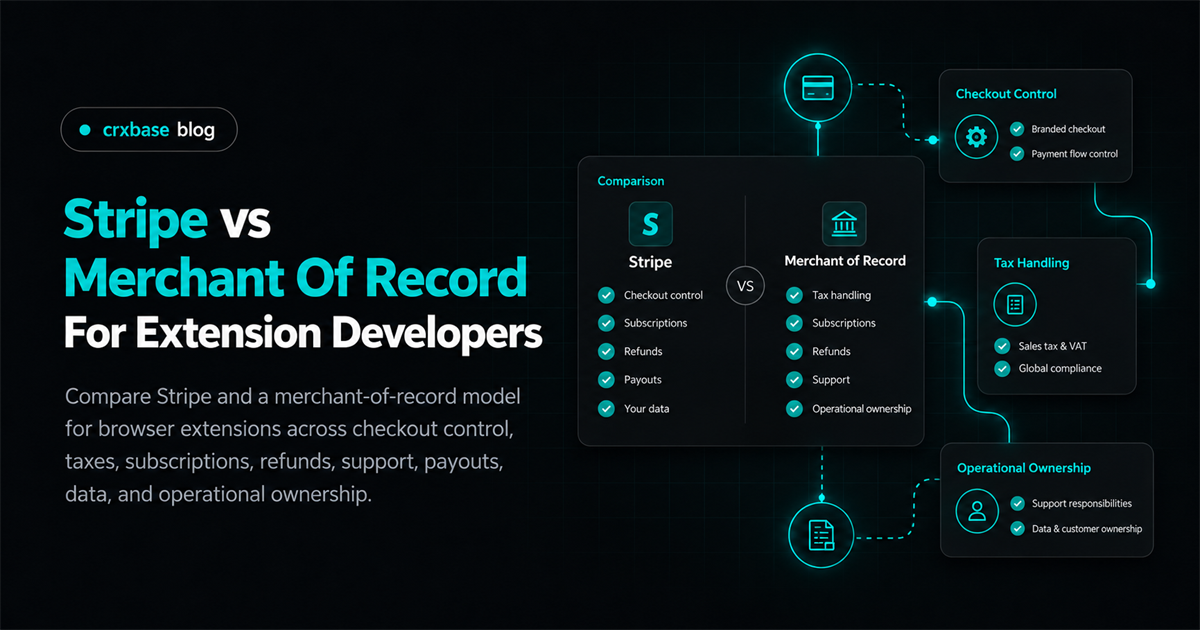
Stripe and a merchant-of-record provider solve different problems. Stripe gives an extension business payment and billing infrastructure that it operates and configures. A merchant of record, such as Lemon Squeezy, positions the provider as the seller for the transaction and takes on defined responsibilities around the sale.
For the extension itself, both choices can use the same basic boundary: the extension starts a hosted checkout, your backend identifies the account, and the extension reads entitlement state from a server. The decision is about who owns the operational work around that payment. Start with the Stripe payments browser extension guide, then use this comparison to decide which responsibilities your team should keep.
TL;DR
- Choose Stripe when control over customers, billing logic, data, and product integration is the priority.
- Choose a merchant-of-record model when a provider's defined tax, refund, chargeback, and payment responsibilities reduce more work than the model's fees and constraints add.
- Neither model removes the need for an authenticated extension account and a server-side entitlement system.
- Merchant-of-record coverage depends on provider terms, countries, product type, and the specific transaction.
Quick comparison
The table is a decision aid, not a contract. Confirm current terms, supported countries, and product restrictions before launch.
| Decision area | Stripe | Merchant of record |
|---|---|---|
| Checkout control | More control over Checkout, branding, billing flow, and API design | Faster path to a provider-hosted sales flow, with provider-specific limits |
| Customer relationship | Your business generally owns the Stripe customer and billing relationship | Provider is the seller of record for the transaction and customer receipts may reflect that |
| Tax operations | You configure the tax approach and evaluate your obligations; Stripe products can assist | Provider handles the responsibilities it accepts as merchant of record |
| Subscription logic | Your backend owns product access rules and reconciliation | Your backend still needs an entitlement mapping, even when provider billing is hosted |
| Refunds and disputes | Your team configures policy and operates the workflow with Stripe | Provider handles defined transaction responsibilities, subject to its policy and terms |
| Data and migration | Direct access to your Stripe objects and integration data | Provider-specific exports, identifiers, and migration constraints need review |
| Payouts | Funds flow according to your Stripe account and product configuration | Provider pays out according to its schedule, fees, reserves, and terms |
| Best starting point | Teams with billing or platform engineering capacity | Small teams prioritizing operational simplicity for a narrow product |
The right winner depends on which row is a hard requirement. A team that needs a custom billing state machine may accept more operational ownership. A solo developer who wants the provider to handle defined sales-tax and transaction duties may accept a narrower integration.
Checkout and browser-extension integration
Both models can work with a browser extension because the extension does not need to collect card details itself. A backend can create or select the provider's checkout URL, return it to the extension, and open it in a browser tab.
Stripe's Checkout documentation describes the hosted Checkout path. Lemon Squeezy's Checkout documentation describes hosted checkout and its API options. The implementation details differ, but the security rule is the same: keep secret credentials and trusted price selection on the server.
extension -> POST /api/billing/checkout { plan: "pro" }
server    -> validates the account and maps the plan to provider data
server    -> returns a hosted checkout URL
extension -> opens the URL in a browser tab
provider  -> sends billing events or exposes an API record
server    -> maps the provider state to extension capabilities
Do not let the provider choice leak into every extension surface. Keep a provider adapter behind your backend and return one internal entitlement shape such as { pro: true, status: "active" }. That makes the paywall and service worker independent from provider-specific object names.
Control, billing logic, and customer data
Stripe is the stronger fit when your product needs direct billing control. You can model customers, Prices, subscriptions, invoices, portal actions, and webhook transitions around your own account system. Stripe's customer documentation describes the Customer resource used for billing and tax information, while the Customer Portal API covers on-demand hosted management sessions.
That control has a cost. Your team must decide how an extension user maps to a billing customer, how a canceled subscription affects access, how failed renewals appear in the product, and how support reconciles a user who paid with a different email. You also own the integration tests and the policy decisions.
A merchant-of-record provider can compress some of the transaction work into its product. Lemon Squeezy's merchant-of-record explanation says it takes responsibility for payments, sales tax, refunds, chargebacks, and PCI compliance as described by its model. That reduces some operational surface, but it does not remove your need to map a buyer to an extension account or define what your paid features mean.
Tax and compliance responsibilities
Tax is the most common reason developers compare these models, and it is also where overconfident summaries create risk. Stripe's Tax documentation describes tools for calculating and reporting tax with Stripe products. Using Stripe Tax is not the same as transferring every legal or operational responsibility to Stripe. Registration, filing, product classification, invoices, and local rules still need review for your business.
Lemon Squeezy's sales-tax and VAT documentation states that Lemon Squeezy is the merchant of record for sales through its platform and explains that it collects and remits sales tax for those sales. The same documentation distinguishes sales-tax handling from tax on a merchant's income or payouts. That distinction matters for an extension business: a provider may simplify transaction tax while leaving business-income questions to you.
Use a written responsibility matrix before choosing. Ask:
- Who is named as the seller on the receipt?
- Who calculates and remits transaction tax in each target market?
- Who handles a refund request and a chargeback?
- Who supplies invoices and tax evidence to the buyer?
- Who handles customer identity, account deletion, and data export?
- What happens if the provider pauses payouts or changes supported countries?
If the answers affect a material amount of revenue, get tax and legal advice for the relevant jurisdictions. This article is architecture guidance, not a tax conclusion.
Subscriptions and entitlement state
Hosted billing does not eliminate product state. The extension still needs to know whether the authenticated account can use a paid capability. Your backend should normalize provider events or API reads into an internal record that includes the account ID, provider customer ID, provider subscription or order ID, plan key, access status, and timestamps.
With Stripe, the webhook entitlement guide covers the event-to-access pipeline. With a merchant-of-record provider, use the provider's webhooks and API to build the same boundary. Store provider identifiers so support can reconcile an account, but do not expose raw billing objects to the extension.
The rule is especially important when users reinstall an extension. The new installation should sign in, call your entitlement endpoint, and restore the account's capabilities. It should not create a new purchase because local storage disappeared.
Fees, payouts, refunds, and support
Compare total operating cost, not just the headline processing fee. Stripe's pricing and tax products, your own support workload, refund handling, accounting, and regional operations all belong in the estimate. A merchant-of-record fee may be higher per transaction while replacing work your team would otherwise perform.
Payout timing and reserves also affect cash flow. Review how each provider handles refunds, disputed charges, failed renewals, currency conversion, and payout holds. A provider can simplify the customer transaction while giving you less control over when money reaches your account.
Support ownership needs equal attention. Customers may contact the provider about receipts or payment errors and your team about extension access. Create a correlation path from your account ID to the provider's customer and transaction ID. Then support can answer “I paid but the feature is locked” without asking the buyer to repeat sensitive payment details.
Who should choose what?
Choose Stripe if you need a custom pricing model, deep integration with an existing account system, direct control over customer billing operations, or a platform architecture that may later use Connect. The Stripe Connect extension platforms guide covers the separate-seller case.
Choose a merchant of record if your product is a straightforward digital subscription, your supported markets fit the provider's terms, and reducing defined transaction-tax and payment operations is worth accepting provider fees and integration constraints. Do not choose it only because the phrase “merchant of record” sounds like a universal compliance shortcut.
Choose neither until you have verified that the provider supports your product, countries, currencies, refund policy, and browser-extension checkout flow. A provider's current documentation and contract outrank a comparison article.
Migration and provider lock-in
Plan the exit before the first paid user. Record your own account ID as the stable product identity and store the provider customer ID separately. Keep plan keys independent from provider Price, Product, Variant, or SKU IDs. Store the minimum billing metadata needed for support and reconciliation, subject to your privacy policy.
When switching providers, the difficult work is usually subscription continuity and customer communication, not changing the extension button. You may need a new consent or checkout event, a plan migration, a refund policy for the old provider, and a careful entitlement transition. Build the extension against your internal capability API so a provider change does not require a full client rewrite.
Conclusion
Stripe wins when control and integration depth matter most. A merchant-of-record provider wins when its defined transaction responsibilities reduce more operational burden than its fees, data constraints, and product limits create. For either choice, keep the extension thin: authenticate the account, open hosted checkout, and read paid capabilities from your server.
Before launch, compare the current official terms and documentation against your actual markets and support model. Then write down who owns checkout, tax, refunds, disputes, data, payouts, and entitlement recovery. That responsibility matrix is more useful than a generic “Stripe versus MoR” verdict.